North vs South Vietnam: Which Should You Visit With Kids? (2026)

So many people ask us whether they should visit the north or south of Vietnam. In fact, we got asked this question so many times before our own trip that it’s the reason this post exists!
However, “should we do north or south Vietnam?” is almost always the wrong question. The real question is what kind of trip you want, because north and south Vietnam feel like two different countries.
We’ve now travelled through Hanoi, Ha Long Bay, Ninh Binh, Hue, Hoi An, Ho Chi Minh City, and the Mekong Delta with our kids, both on one itinerary and on separate ones. We think we’re now pretty qualified to answer the question!
So here’s how the two halves of Vietnam actually compare, what surprised us, and how to decide which fits your family (or whether, like us, you should just do both).
(And don’t forget to check out this post on Vietnam with kids)
Note: This post contains affiliate links. If you click through and make a booking, we earn a small commission at no cost to you. This helps us keep A Winter Escape up and running.
North vs South Vietnam At A Glance
| North Vietnam | South Vietnam | |
|---|---|---|
| Key cities and regions | Hanoi, Ha Long Bay, Sapa, Ninh Binh | Ho Chi Minh City, Mekong Delta |
| Vibe | Historic, dramatic landscapes, cooler | Fast-paced, tropical, energetic |
| Best weather | October to April | December to April (dry season) |
| Best for families with | Older kids who can handle more walking and cooler weather | Kids who want beach time and warmer days year-round |
| Ideal trip length | 5 to 7 days | 4 to 6 days (can extend by adding Nha Trang) |
| How to get between them | Overnight sleeper train or a 2-hour flight | Same |


What North Vietnam Is Like With Kids
Hanoi is chaotic in the best way. The Old Quarter is a sensory overload for kids (in a good way) and it’s where you’ll find some of the best street food in the country (the North is home to phở and bún chả, two of Vietnam’s most famous dishes).
From Hanoi, most families head out to Ha Long Bay or Lan Ha Bay for a cruise among the limestone karsts, or inland to Ninh Binh, which honestly might have been the most underrated place we’ve visited in Vietnam.
What we love about the North of Vietnam is the history. Whether modern or ancient, historical sites and experiences are everywhere you turn. It’s also a fantastic place to experience more immersive cultural traditions.
The north is cooler and greyer for much of the year, which can catch families off guard if they’re picturing tropical Vietnam. Pack layers, especially between November and February.
Read our full Hanoi travel guide for where to stay and what to do with kids.
What South Vietnam Is Like With Kids
Ho Chi Minh City (still called Saigon by most locals) is a different energy entirely. It’s hotter (most of the year), faster, and more overtly modern than Hanoi. I’ve always found the people here to be more outgoing and laid-back (perhaps because Hanoi is the government seat, so the vibe feels more ‘official’ there). You’ll still find plenty of historical sites
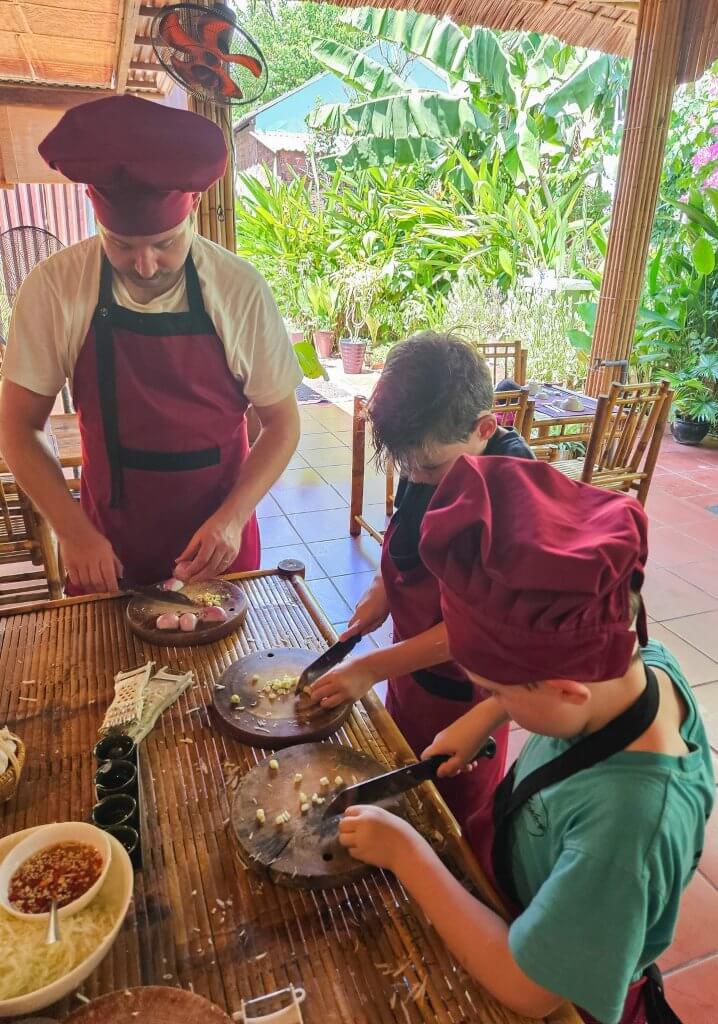
South of the city, the Mekong Delta is a genuinely unique day trip or multi-day itinerary. Heading through the Delta region of Vietnam is an insight into a completely different way of life – one lived in harmony with the water. Exploring this region allows you to experience the famous floating markets, coconut and jackfruit farms, basa fisheries and some incredible scenery you won’t find anywhere else.
North of Saigon but still in the southern region are some fantastic towns worth a night or two (or more if you just want somewhere to slow down) such as the mountain escape of Da Lat and the Vietnam’s Gold Coast, Nha Trang.
If beach time matters to your family, the south gives you easier access to warm-water coastline than the north does for most of the year.
Don’t Forget Central Vietnam
Most “north vs south” content skips this, but if you’re planning a longer trip, central Vietnam bridges the two. Hue and Hoi An give you imperial history and lantern-lit old towns without the intensity of the two big cities. We travelled between Hanoi and Hue by overnight sleeper train, which turned a logistics problem into one of the highlights of the trip.
Hue is one of the ancient capitals, and worth it for both ancient and modern historical insights. It’s also a quieter city, so a lovely place to catch your breath!
Hoi An, while touristy, attracts visitors for a big reason – the UNESCO-listed old city is in our opinion one of the most beautiful backdrops in the world to just wander around. Hoi An is also famous for its tailors.

Weather: When Should You Go?
- North Vietnam: Best October to April. Can get genuinely cold (10 to 15°C) in Hanoi and Sapa December to February.
- South Vietnam: Warm year-round. Dry season is December to April, rainy season May to November (expect short, heavy downpours rather than all-day rain).
- Whole country: If you’re doing a full north-to-south trip, aim for February to April, when both ends are at their best.
Our Verdict: North, South, or Both?
If you only have a week, pick one region and go deep rather than rushing both. Families wanting dramatic scenery, cooler weather (October – April) and a slower pace should lean north. Families wanting heat, energy and easy beach add-ons should lean south.
But if you have 10 days or more, do both and let central Vietnam connect them. This is genuinely one of the best family trips we’ve done, and doing the full north-to-south route meant we never felt like we were rushing any one place. Our complete Vietnam itinerary will help you do this right.
Whichever you choose, we always travel with Cover-More for peace of mind, especially with a packed itinerary across multiple regions.
How to Travel Between North and South Vietnam
You’ve got three realistic options:
- Overnight sleeper train: Our pick for the Hanoi to Hue leg. It’s an experience in itself and saves you a night of accommodation. Read our full sleeper train guide before booking through 12Go.
- Domestic flights: Fastest option if you’re short on time, roughly two to three hours between Hanoi and Ho Chi Minh City.
- Multi-stop road trip: More flexible but time-heavy, only worth it if you have 2+ weeks (and you’ll need to hire a driver).


FAQ
Is Hanoi north or south Vietnam?
Hanoi is in the north. It’s Vietnam’s capital and the natural starting point for exploring Ha Long Bay, Sapa and Ninh Binh.
Is north or south Vietnam better for families?
It depends what you want. North Vietnam suits families wanting dramatic scenery and cooler weather, while south Vietnam suits families wanting heat, energy and beach time. Many families, including ours, do both by travelling the length of the country.
How long do you need to see both north and south Vietnam?
We’d recommend at least 10 days to comfortably cover both without rushing, including a stop in central Vietnam along the way.
What’s the best way to travel from north to south Vietnam?
The overnight sleeper train is a great option for shorter legs like Hanoi to Hue, while a domestic flight makes more sense for the full Hanoi to Ho Chi Minh City journey.
Is south Vietnam warmer than north Vietnam?
Yes. South Vietnam stays warm year-round, while north Vietnam can get cold, especially December to February in Hanoi and Sapa. (North Vietnam does get very hot May- September though)
Do I need a different packing list for north vs south Vietnam?
Yes. Pack layers for the north, especially outside of summer, and lightweight, breathable clothing for the south year-round.